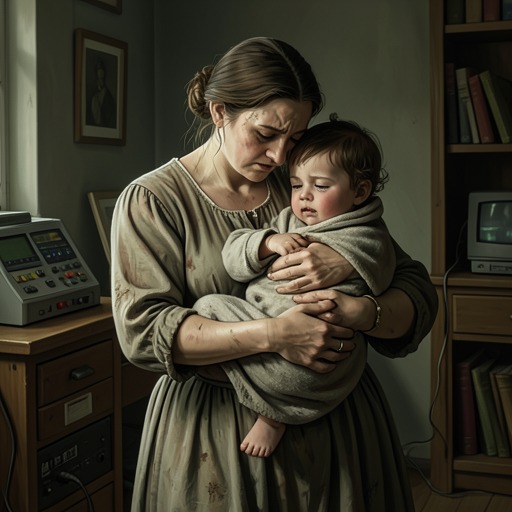
Nina drugs Cecelia and attempts to drown her before overdosing
The HousemaidNina’s attempt to drown Cecelia and overdose is a past crisis that Millie first encounters through Amanda’s account, then understands as a source of leverage in Nina’s marriage to Andrew. Its significance reaches beyond the immediate attempt: the episode leaves Nina’s mental-health history available for Andrew to invoke when she considers escape, while Cecelia’s safety remains the pressure point around which his control operates.
The account Millie hears
Millie learns about the episode while looking for information about why people call Nina crazy. Amanda responds that Nina had been hospitalized and that Cecelia was a baby at the time. Her account is blunt: Nina drugged Cecelia, put her in a bathtub with the water running, and then took a large quantity of pills herself. Amanda adds that Andrew was at his office in the city and became concerned when he could not get through to Nina. He called the police, who, according to Amanda, arrived only moments before it would have been too late.
The incident reaches Millie as reported history rather than something she witnessed. She is startled by the severity of what Amanda describes. Before asking, Millie had expected a story about an ordinary social dispute or an outburst over a trivial matter; instead, she hears that Nina tried to kill her daughter and herself. Millie has heard the story from enough people to take it seriously, and she concludes that Nina really did try to kill Cecelia. The conversation therefore shifts her understanding of the rumors: they concern a specific crisis, not merely a vague reputation for erratic behavior.
Andrew’s intervention and the episode’s aftermath
In Amanda’s version, Andrew is not present when the attempt begins. He is in the city for work, and his inability to reach Nina prompts him to call the police. Amanda presents that call as the timely intervention that prevented the situation from becoming fatal. The available account does not describe the police response in detail, but Cecelia and Nina both survive; the event is remembered as an attempt, not a death.
The revelation unsettles Millie partly because it conflicts with what she sees in Nina’s relationship with Cecelia. Millie believes Nina clearly loves her daughter, and that apparent affection makes the reported act harder for her to reconcile. At the same time, the episode’s reality is reinforced by the way it circulates among people in the town and by Nina’s later circumstances. Millie’s response is not to dismiss the account, but to hold together two facts that seem difficult to square: Nina’s visible care for Cecelia and her past attempt to harm her.
A history turned into leverage
Nina later explains that her history of mental-health problems makes escape especially difficult. She believes Andrew could tell the police that she had kidnapped Cecelia and intended to hurt her again, and that her past would make the accusation persuasive. The earlier attempt thus becomes more than a private catastrophe: in Nina’s account, it gives Andrew a ready-made story with which to undermine her credibility and threaten her relationship with her daughter. Her fear is not only that he will punish her, but that others may accept his version of events because they know what she once did.
Andrew’s control also reaches Cecelia through rules and threats that exploit the same fear. Nina says that when Cecelia does something Andrew considers unacceptable, he punishes Nina instead. He buys Cecelia itchy, frilly dresses she dislikes and that other children mock; Cecelia wears them because she knows her mother may otherwise disappear for days. Nina accepts punishment rather than risk it falling on her daughter, while fearing that Andrew might eventually punish Cecelia directly.
Nina also describes Andrew repeatedly placing peanut butter in the pantry despite knowing that Cecelia is allergic. Nina throws it away, only for it to reappear, sometimes followed by punishment for Nina. Andrew occasionally puts a small amount into Cecelia’s dinner, causing welts and discomfort. Nina says the allergy is not life-threatening, but the deliberate exposure functions as a demonstration that he can make Cecelia suffer and that Nina cannot reliably prevent it. Against this pattern, the earlier bathtub attempt is not simply a piece of scandalous history: it is the past Andrew can use to make Nina fear that any attempt to leave could cost her custody or expose Cecelia to further danger.
Narrative significance
The episode is first presented through gossip, with Millie listening as an outsider to Nina’s past. That structure makes the revelation both consequential and incomplete: Amanda supplies the circumstances, while Millie registers the shock and tries to reconcile the account with the mother she has observed. Later, Nina’s own account of her trapped position clarifies how the event continues to shape her choices, especially her belief that the police may not regard her as a credible protector of Cecelia.
The episode also complicates the language of protection. Andrew’s call to the police is described as the action that brought help when Nina and Cecelia were in immediate danger. Yet Nina later portrays him as using the same history to keep her from leaving and as threatening Cecelia through punishments, clothing, and deliberate exposure to an allergen. The event therefore carries two linked meanings in the story: it is a real act of grave danger, and it becomes part of the mechanism by which Andrew can constrain Nina long after the immediate crisis has passed.